How to Choose the Right Fitness App in 2026
Most people are comparing the wrong fitness apps. Here’s why. 👇
By Reset90 AI
Search for the “best fitness app” and you’ll find hundreds of rankings. The problem is that most of those lists compare apps that were never designed to solve the same problem. A workout planner isn’t trying to replace a nutrition coach. A body tracking app isn’t trying to replace a habit coach. Before choosing an app, it’s more useful to understand what job you actually need it to do.

1. The Four Types of Fitness Apps
Most fitness apps fit into one of four categories. Each category is excellent at solving a specific problem. Understanding those differences is much more useful than reading another “Top 10 Apps” list.
I. Workout Planning Apps
These apps answer one question: What should I train today?
Typical features include:
Workout generation
Progressive overload
Exercise library
Training logs
Examples:
Fitbod
Hevy
GymStreak
Alpha Progression
Best for:
People who already understand nutrition and simply want better programming.
II. Nutrition Apps
Nutrition apps focus almost entirely on food. Instead of planning workouts, they help you stay within your calorie target and hit your protein goals.
Examples:
MacroFactor
Cronometer
MyFitnessPal
Best for:
People whose biggest challenge is diet rather than training.
III. Progress Tracking Apps
These apps don’t tell you what to do. Instead, they answer a different question: “Is what I’m doing actually working?” Progress tracking has evolved beyond simple weight logging. Modern tools use photos, measurements, or AI analysis to help visualize changes over time.
Examples:
GainFrame
MeThreeSixty
ZOZOFIT
Best for:
People who already have a training system and want objective feedback.
IV. Habit & Accountability Apps
Some people don’t struggle with knowledge. They struggle with consistency. Habit-focused apps emphasize reminders, routines, streaks, and accountability instead of programming.
Examples:
Noom
BetterMe
Best for:
Building long-term consistency.

2. One Thing Most Apps Have in Common
Notice something?
Every category focuses on one part of the journey.
A workout app assumes you already know what to eat.
A nutrition app assumes you already know how to train.
A tracking app assumes you’ve already built a routine worth measuring.
That’s not a flaw. It’s simply the job those products were designed to do.

3. A Different Approach: Transformation Systems
Recently, a newer category has started to appear.
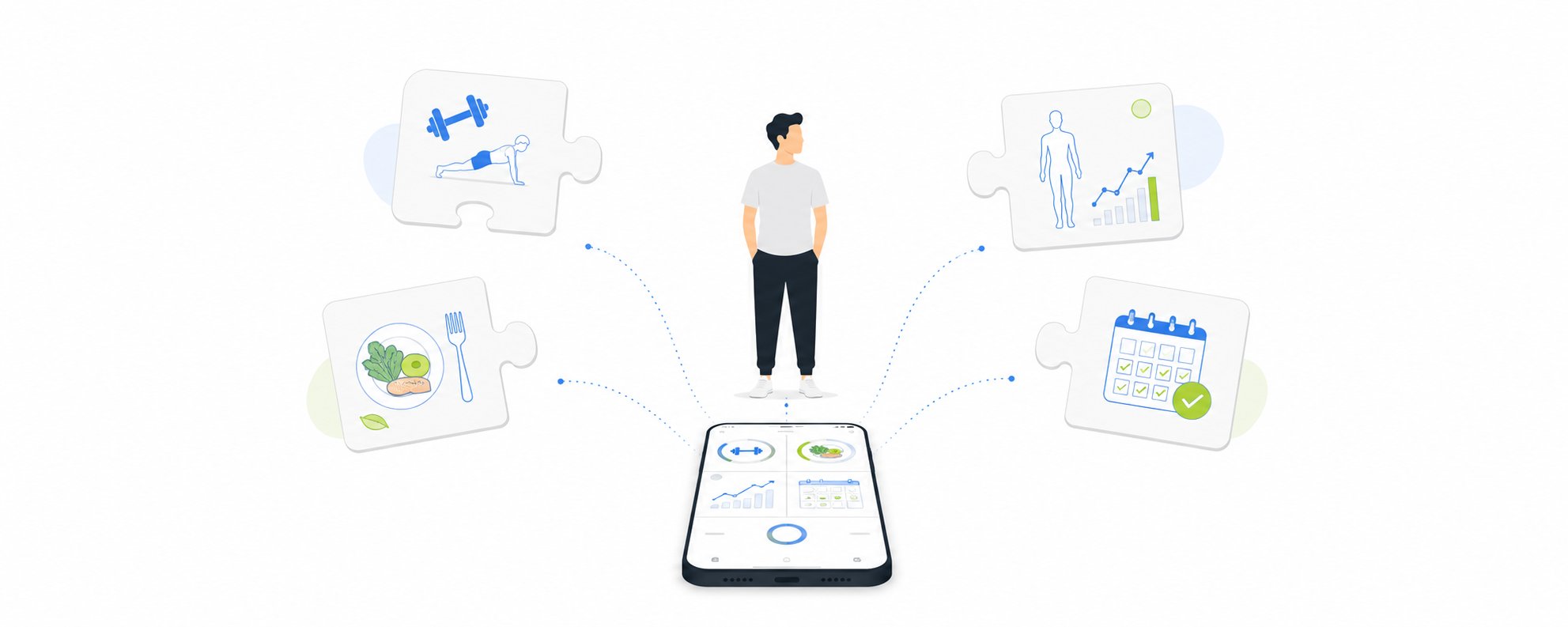
Instead of optimizing one task, these apps try to connect multiple parts of the journey into a single workflow. The goal isn’t simply to generate workouts or count calories.
The goal is to reduce decision fatigue by answering one question every day: “What should I do today to get closer to my goal?” Reset90 AI is one example of this approach.
Rather than focusing on a single feature, it combines structured training, nutrition guidance, progress tracking, and coaching into one daily workflow.

4. Which Type of Fitness App Do You Actually Need?
Most people compare apps. A better question is: Which category actually solves my problem?

🏋️ I. Workout Planning Apps
Body
Best for
People who already understand nutrition but want better training structure.
What they do well
Generate personalized workout plans
Progressive overload
Exercise tracking
Training history
Popular apps
Fitbod
GymStreak
Hevy
Alpha Progression
🥗II. Nutrition Coaching Apps
Best for
People whose biggest challenge is hitting calorie and protein targets consistently.
What they do well
Calorie tracking
Macro management
Meal logging
Food database
Popular apps
MacroFactor
Cronometer
MyFitnessPal
📈 III. Progress Tracking Apps
Body
Best for
People who already have a workout plan and want objective feedback on whether it’s working.
What they do well
Before & after comparisons
Body measurements
Progress photos
AI body analysis
Popular apps
GainFrame
MeThreeSixty
ZOZOFIT
✅ IV.Habit & Accountability Apps
Best for
People who know what to do but struggle to stay consistent.
What they do well
Daily reminders
Habit tracking
Streaks
Accountability
Popular apps
Noom
BetterMe
Habitify
Transformation Systems
Body
Best for
People who want one app to guide the entire journey instead of switching between multiple tools.
What they do well
Daily workout guidance
Nutrition targets
Progress tracking
Coaching
Long-term consistency
Example
Reset90 AI
5. Final Thoughts
One thing became clear while researching today’s fitness apps.
The biggest difference isn’t the number of features. It’s the problem each product was designed to solve.
Once you understand that, choosing the right app becomes much easier.
The best fitness app isn’t necessarily the one with the most features. It’s the one you’ll still be using three months from now.
Now I’m curious: Which category of fitness app are you using today?
The Reset90 system
Useful ideas for building a body you can keep.
Training notes, product updates, and practical ways to make your next 90 days count.
Start your next 90 days
Get your daily training, nutrition, and check-in priorities in one adaptive system.
 Download on theApp Store
 Coming soon on theGoogle Play