

How to Stay Consistent When Motivation Drops
Motivation is useful, but it is not a dependable schedule. Build a training routine that still works when the excitement disappears.
By Reset90 AI
Motivation is a great way to start a workout. It is a terrible way to schedule the next twelve weeks.
Some days you will feel excited. Some days you will feel neutral. Some days you will be negotiating with yourself from the sofa. Consistency comes from having a plan for all three versions of you.
The goal is not to become motivated every day. The goal is to make starting simple enough that motivation does not have to do all the work.
Make the starting line smaller
“Complete a hard workout” is a heavy instruction. “Put on your shoes and warm up for five minutes” is easier to begin.
Use a two-step commitment:
- Commit to starting the warm-up.
- Decide what comes next after the warm-up.
This is not tricking yourself. It is separating the decision to begin from the decision to continue. On low-energy days, that difference matters.
Have a minimum session ready
Your minimum session should be short enough to fit into a difficult day and meaningful enough to feel real. It might be three rounds of a squat, push, and pull variation. It might be a brisk walk followed by mobility. It might be one main lift and one accessory.
The minimum session is not your permanent goal. It is the bridge that keeps the routine alive when the full version does not fit.

Remove decisions before the day starts
Consistency gets easier when fewer choices are waiting for you. Prepare the next session in advance:
- Choose the workout or movement focus.
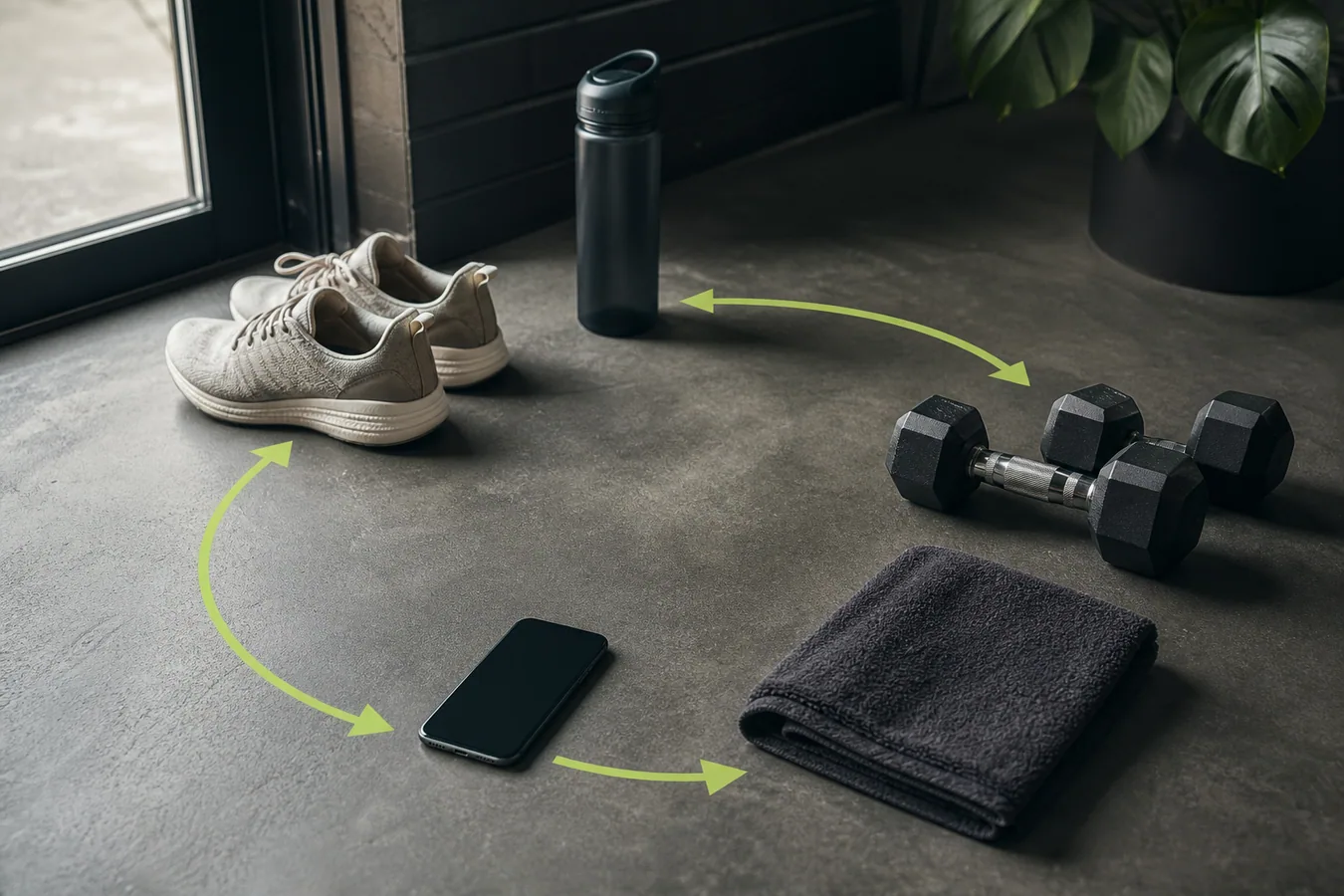
- Put your shoes and clothes where you can see them.
- Decide the minimum version before you need it.
- Pick the time based on your real energy, not your ideal identity.
A little preparation turns the workout into the next step in a sequence instead of a fresh debate.
Use a reliable cue
Pick something that already happens: finishing your morning coffee, closing your laptop, arriving home, or putting your child to bed. Attach the first workout action to that cue.
The cue does not have to feel inspiring. It just needs to happen often enough that your brain starts to recognize the pattern. Shoes by the door, a mat beside the sofa, or a calendar reminder can all work as quiet prompts.
Measure attendance before performance
Progressive overload and performance matter, but they are difficult to evaluate if you are not showing up. For the first few weeks, track whether you completed the planned action and whether you adapted it intelligently.
That gives you two wins to notice: completing the full session and completing the right smaller session. Both teach you how to stay in the process.
Stop using one bad day as evidence
A workout can feel flat. Your energy can be low. Your numbers can move backward for a week. None of those moments tells the whole story.
Look at a wider window. Are you training more often than last month? Are you recovering? Are you making fewer all-or-nothing decisions? Those are better questions than “Was today perfect?”
Build a routine that survives real life
Motivation will come back, but you should not have to wait for it. A flexible plan, a minimum session, and a simple cue can carry you through the flat weeks.
Read the 90-day workout plan for busy people to see how these ideas fit into a longer structure. When you want a system that adjusts the next priority as your week changes, try Reset90 AI.
Note: This article is general educational information, not medical advice. Adjust exercise for your experience and health needs.
The Reset90 system
Useful ideas for building a body you can keep.
Training notes, product updates, and practical ways to make your next 90 days count.
Start your next 90 days
Get your daily training, nutrition, and check-in priorities in one adaptive system.
 Download on theApp Store
 Coming soon on theGoogle Play
Keep reading
Related articles

How Sleep Affects Your Training Progress
Sleep is not a bonus feature for serious athletes. It is part of the recovery system that makes your training easier to repeat.
Read article
How Much Protein Do You Need to Build Muscle?
A clear, practical explanation of protein targets for active people, including how to use a range without turning every meal into a calculation.
Read article
How to Create a Workout Plan That Adapts to Your Schedule
A practical way to build a workout plan around your real week, including what to do when work, travel, or low energy changes the plan.
Read article